- The Deep View
- Posts
- Anthropic's Cowork widens its lead with pros
Anthropic's Cowork widens its lead with pros

The Deep View
January 14, 2026


Welcome back. Investors are always chasing the next moonshot. Leave it to a couple of engineers to get it literal about it. Y Combinator, Nvidia, and SpaceX have all invested in a new startup, GRU Space, that aims to build the "First Lunar Hotel" by 2032 and has started taking bookings at $416,667 per night. A video on X shows a brief look at the design. The two-person startup says it will reinvest the profits from its Moon hotel to build structures on Mars, asteroids, and beyond as part of its journey toward Galactic Resource Utilization. At least the brightest minds of our generation are no longer spending their lives getting people to click more ads on Google and Facebook. —Jason Hiner
1. Anthropic's Cowork widens its lead with pros
2. OpenAI’s Jony Ive mystery device: An AI earbud?
3. China cracks AI training with fewer chips
PRODUCTS
Anthropic's Cowork widens its lead with pros

Claude Code had already set the standard for AI-powered coding assistance. Now, Claude Cowork wants to become the standard for the rest of the workplace.
Anthropic’s latest app, released Monday as a research preview for Claude Max subscribers (the $100 to $200 per month tier), gives users an agentic assistant that handles tasks autonomously when given access to specific folders. Relying on the same agentic architecture that powers Claude Code, the product can handle complex tasks on users’ behalf, running locally on your device via Claude Desktop rather than requiring users to open a terminal. It's only on macOS for now.
Though still rough around the edges given that it’s in preview, Claude Cowork can do a lot. The agent can clean up your messy desktop, summarize unruly digital notes and create reports and spreadsheets from a growing stack of receipt screenshots.
Though many of these capabilities were already possible with Claude Code, Anthropic’s new product sends a clear message: it wants to be the go-to agentic tool for the entire workplace, not just developers. It underscores that Anthropic is keenly honed in on dominating the enterprise tech space by making itself as useful as possible.
Direct AI rivals, like OpenAI and xAI, have been seeking to cement their places in the enterprise workflow, with OpenAI hiring a new head of AI strategy and adoption to boost its enterprise endeavours last week, and xAI launching Grok Business and Enterprise plans in December. Traditional enterprise tech firms, meanwhile, have been trying to figure out where AI fits in, such as Slack releasing its own agentic AI upgrade on Tuesday.
And though Claude Cowork is still in its early days, having reportedly been developed in just a week and a half after being prototyped before the winter holidays, Anthropic’s enterprise AI prowess could spell trouble for competitors in the space.
Tools like Claude Cowork “Are flipping the script a bit on where you're going to spend your time and do the work and get the outputs of your labor,” Brian Jackson, principal research director at Info-Tech Research Group, told The Deep View.

Anthropic’s success in enterprise tech adds up. The company has built a reputation as the “good guys” of AI, with co-founders Dario and Daniela Amodei consistently espousing the view that AI safety, responsibility, and innovation must go hand in hand. Compare that to the PR crises regularly spawned by competitors like OpenAI and xAI. Enterprises are notoriously risk-averse, and that makes the safety-conscious Anthropic a much more reliable option. Meanwhile, Anthropic still deploys new solutions like Cowork far faster than legacy competitors such as Microsoft and Google.

TOGETHER WITH ORACLE NETSUITE
See how forward-thinking finance leaders drive real impact

Finance leaders who take a strategic approach to AI are improving decision-making, increasing efficiency, and positioning their organizations for long-term success.
In this guide, AI expert and finance leader Ashok Manthena outlines the traits and tactics of AI champions—and how you can develop them at your organization.
You’ll discover how to:
Build a strong business case for AI.
Integrate AI into your processes and planning.
Form cross-functional teams that bring together experts.
And so much more!
PRODUCTS
OpenAI’s Jony Ive mystery device: An AI earbud?

OpenAI has been accused of a lack of focus for its forays into a wide variety of initiatives, from healthcare to third-party apps to a web browser to its Sora video generator to AI data centers. OpenAI CEO Sam Altman's comments targeting Apple as a bigger long-term competitor than Google certainly haven't quelled those fears of overreach.
Altman reportedly told a group of journalists that the AI battles of the future will be won through devices rather than frontier models. The fact that Apple teamed up with Google rather than OpenAI to power the next version of Siri has likely only fueled Altman's competitive spirit.
Now we have a new report out of China that OpenAI is working with manufacturing giant Foxconn on an AirPod-like audio device codenamed "Sweetpea" that wraps around the ear and functions as an audio-powered AI assistant. Sounds like a form factor similar to a classic Bluetooth headset or a high-end pair of earbuds.
The report, from supply chain leaker SmartPikachu, says OpenAI is using cutting-edge hardware for the device (including a 2nm processor), plans to manufacture 40-50 million devices in the first year, and that will be released around September.
The planned volume of devices might be the biggest surprise, if correct. For context, Meta's Ray-Ban AI smart glasses, which have similar features, sold about 2-3 million pairs last year, and Apple currently sells about 65 million pairs of AirPods per year. To nearly match AirPods in their first full year would be quite a feat for OpenAI's device.
Another interesting insight from the report was that OpenAI is working on a total of up to 5 devices that include a "home style device" (sounds like an Amazon Alexa smart speaker) and a pen. The pen reference would corroborate a recent report that OpenAI was working on an AI device shaped like a traditional writing instrument.
All in all, if OpenAI's Jony Ive mystery device turns out to be a pair of super-smart AI earbuds, that wouldn't be the worst outcome — especially if they are priced under $400. After all, earbuds are widely used and very utilitarian. I highly suspect that Altman and Ives were originally working on a device very similar to the ill-fated Humane AI Pin, since they spoke extensively about a device with no screen that can understand your visual and audio context. And then they eventually delayed their device and went back to the drawing board when the Humane AI Pin was widely panned by reviewers and early customers. An AI-powered audio device that can do most of the same things would be a good pivot.

TOGETHER WITH GRANOLA
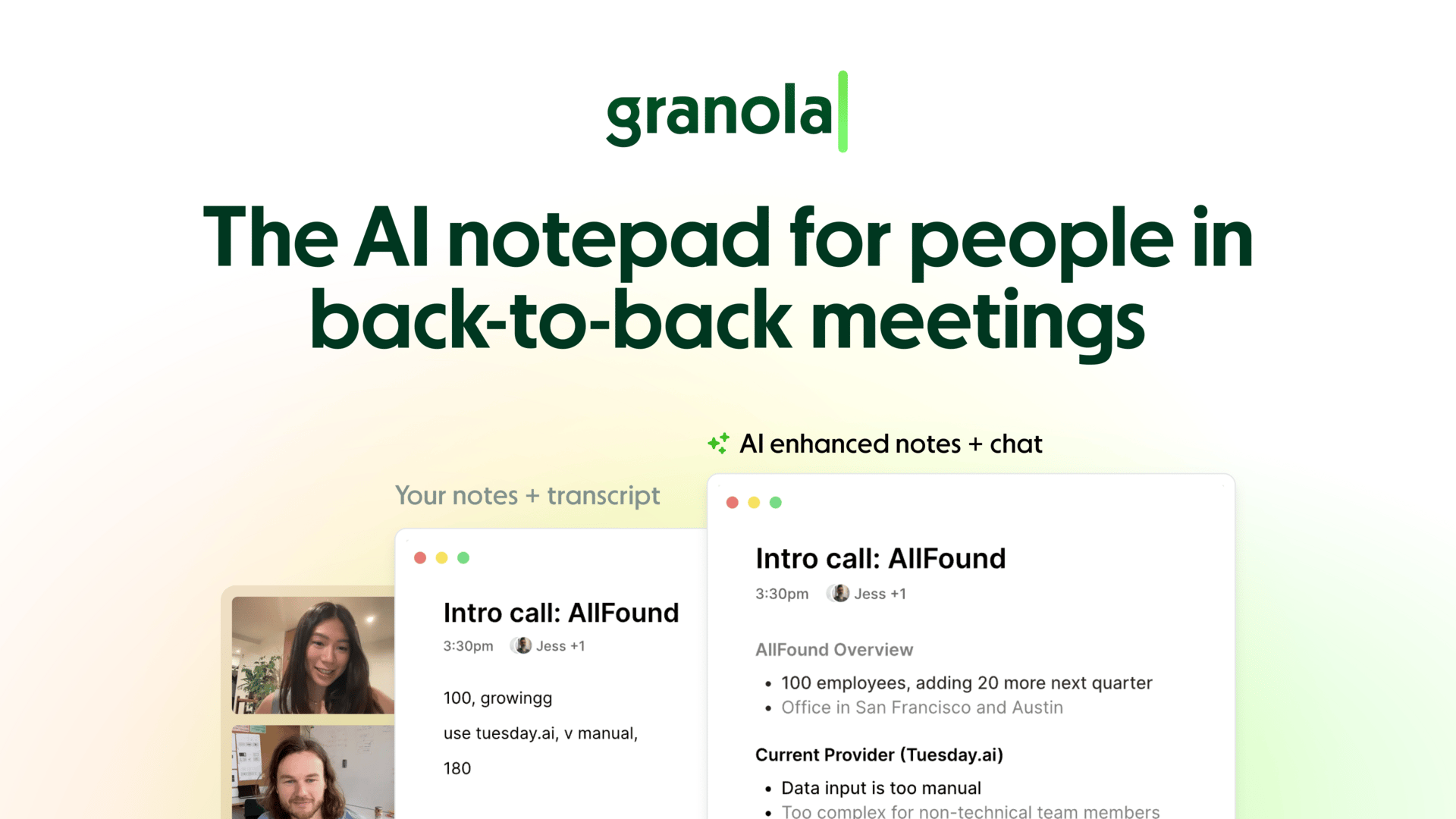
The AI notepad for people in back-to-back meetings
Looking for an AI notetaker for your meetings?
Granola is a lot more.
Most AI note-takers just transcribe what was said and send you a summary after the call.
Granola is an AI notepad. And that difference matters.
You start with a clean, simple notepad. You jot down what matters to you and, in the background, Granola transcribes the meeting.
When the meeting ends, Granola uses your notes to generate clearer summaries, action items, and next steps, all from your point of view.
Then comes the powerful part: you can chat with your notes. Use Recipes (pre-made prompts) to write follow-up emails, pull out decisions, prep for your next meeting, or turn conversations into real work in seconds.
Think of it as a super-smart notes app that actually understands your meetings.
RESEARCH
China cracks AI training with fewer chips

DeepSeek may have had a hand in breaking another boundary in AI efficiency.
A paper co-authored by DeepSeek founder Liang Wenfeng and researchers from Peking University outlines a model-training technique that overcomes GPU memory constraints while achieving “aggressive parameter expansion.”
To put it simply, this technique can do a whole lot more with a whole lot less. Using a technique called “conditional memory,” this system can efficiently recall more basic information, rather than wasting memory and compute on “trivial operations.” In a test on a 27-billion-parameter model, the researchers found that this method surpassed several industry benchmarks and left room for complex reasoning tasks.
The breakthrough comes as DeepSeek readies to drop V4, its next-generation model that reportedly surpasses competitors in coding capabilities. But DeepSeek and other Chinese AI firms face several challenges:
Export restrictions on advanced AI chips have strangled resources in China, forcing these firms to rely on less powerful homegrown hardware.
And the AI industry broadly faces a massive shortage in high-bandwidth memory as prices for this chip component surge.
These challenges could crunch the market so thoroughly that some Chinese AI leaders are betting that the US will remain in the lead on frontier model innovation for the foreseeable future. Justin Lin, head of Alibaba’s Qwen models, said at a summit in Beijing on Saturday that current compute resources are “stretched thin — just meeting delivery demands consumes most of our resources.”
Still, China leads the market on open-weight AI development: Analysis from Stanford’s Institute for Human-Centered Artificial Intelligence found that downloads of Alibaba’s Qwen models eclipsed Meta’s Llama models on Hugging Face in 2025. And the ecosystem extends far beyond DeepSeek and Alibaba, with these open-weight models performing “at near-state-of-the-art levels across major benchmarks and leaderboards.”
China doesn’t need to beat the US on frontier proprietary models. Rather, China is winning the AI market with cheap, efficient, open-source models that deliver powerful capabilities without incurring high costs. Many US companies are already leaning on these affordable Chinese AI models. As the cost to deploy massive proprietary AI from major model providers continues to rise, many may start to question the costs versus the benefits as open-source models close the performance gap.
LINKS

Anthropic expands Labs, its team dedicated to Claude product development
Chinese app that checks if you’re alive tops app store charts
Anthropic invests $1.5 million in Python Software Foundation
Voice AI startup Deepgram raises $130 million at $1.3 billion valuation
Cerebras in talks to raise $1 billion at $22 million valuation
Roblox’s AI-powered age checker faces backlash for labeling kids as adults

Chamber: Lets you put your AI infrastructure, governance and resource management needs on autopilot.
Veo 3.1: The latest edition of Google’s video AI model is now available in the Gemini API and AI Studio, now with upsampling to 1080p and 4K.
MedGemma 1.5: The latest edition of Google’s medical model, now with medical imaging support.
Session Pilot: A transcription and summarization tool that operates completely offline.

Salesforce: SMTS, AI Research
Capital One: Applied Researcher II (AI Foundations)
Nvidia: Senior GenAI Engagement Lead, Partner Platforms
Google: Senior Research Scientist, Google Research


A QUICK POLL BEFORE YOU GO
Would you consider buying a new form-factor AI device made by OpenAI? |
The Deep View is written by Nat Rubio-Licht, Jason Hiner, Faris Kojok and The Deep View crew. Please reply with any feedback.

Thanks for reading today’s edition of The Deep View! We’ll see you in the next one.

“The reflections looked correct on the windows, snow [was] realistic on cars and road.” |

“There is no exit from the fire escapes… I only see one lamp post, this doesn't make sense for a city street.” |


Take The Deep View with you on the go! We’ve got exclusive, in-depth interviews for you on The Deep View: Conversations podcast every Tuesday morning.

If you want to get in front of an audience of 450,000+ developers, business leaders and tech enthusiasts, get in touch with us here.