- The Deep View
- Posts
- DeepSeek readies its next AI disruption
DeepSeek readies its next AI disruption

The Deep View
January 12, 2026


Welcome back. OpenAI's LinkedIn competitor may arrive sooner than expected. On X, TestingCatalog posted screenshots of a new Jobs tab inside ChatGPT. OpenAI's Fidji Simo announced last September that in 2026 the company would launch its own AI-powered jobs platform, along with a worker certification program to verify AI skills. OpenAI is betting that it can use AI to super-charge matching employees to the best prospective jobs when they open, and do the same for employers looking to find the most outstanding candidates faster and at a higher quality rate than the traditional hiring process. We also shouldn't underestimate the urgency of AI companies trying to win back the narrative on AI's impact on jobs. —Jason Hiner
1. DeepSeek readies its next AI disruption
2. Meta goes nuclear to power AI supercluster
3. Grok ditches nudes for vibe coding, enterprise
OPEN-SOURCE
DeepSeek readies its next AI disruption
DeepSeek is preparing to rattle the AI world once again.
The Chinese AI firm is reportedly preparing to launch its next-generation model, V4, featuring code-generation capabilities that could surpass competitors like OpenAI and Anthropic, according to The Information.
The release would mark another major competitor in the open-source market as open-source models continue to catch up with their closed-source counterparts. But it’s not the only one:
Last week, web browser firm Mozilla revealed plans to invest in open-source AI by developing a “modular framework” that consolidates the scattered components of open-source AI development into one place. Mozilla CTO Raffi Krikorian said in a blog post that the open source ecosystem is “deeply fragmented.”
Open-source AI was also all over CES last week, with many startups using open models in their demos because of their accessibility. Nvidia CEO Jensen Huang called out open models in his keynote, noting that open models are “still solidly six months behind the frontier models” but are consistently “getting smarter and smarter.”
The goal of open models, and of open source innovation generally, is to democratize the technology. Open ecosystems allow anyone to access and innovate using powerful models without shouldering the expense. That kind of access could be tempting to enterprises, especially as AI costs become untenable.

A new DeepSeek model would be a win for the open-source AI ecosystem as a whole. However, it also represents another success for the open model market in China. Meanwhile, in the US, the open-source market is floundering, especially as Meta, one of the biggest providers of US-native open-source models, considers making its next model proprietary. Though support from organizations like Nvidia and Mozilla, as well as the success of firms like Reflection AI, give the US ecosystem a boost, many firms are opting to use open models from Chinese firms instead.

TOGETHER WITH SNOWFLAKE
What’s your AI Agent’s GPA?
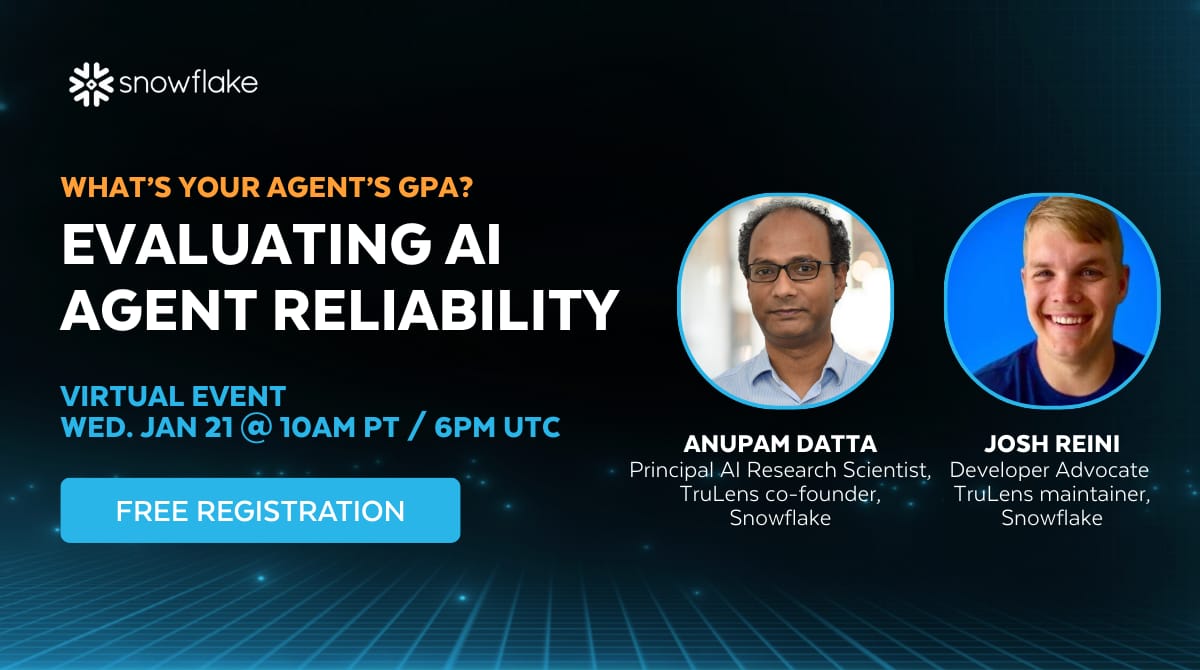
AI agents fail in ways you can’t see. These hidden errors inflate compute costs, spike latency, and turn brittle agents into production risks.
Agent GPA (Goal-Plan-Action) is a new open-source framework that outperforms standard LLM evals with 95% accuracy by making agent reasoning, planning, and actions visible.
Join the Jan 21 webinar with the Snowflake AI Research team to learn how Agent GPA scores agents across 9 behaviors, diagnoses hallucinations and bad tool use via traces, and evaluates agents at scale – so you can catch failures before they cost you.
Register free (or get the recording!)
ENERGY
Meta goes nuclear to power AI supercluster

Nuclear power is staging a comeback in the U.S. — largely due to the voracious energy demands of AI — and Meta just became one of the largest corporate buyers of nuclear power in U.S. history.
On Friday, the company announced that it had signed three deals with nuclear companies to onboard 6.6 GW of power by 2035. This energy boost is particularly needed for Meta's AI factories, including its AI supercluster, "Prometheus," which is scheduled to come online later in 2026 in New Albany, Ohio.
One of Meta's three deals is with Vistra to increase power production at existing plants in Pennsylvania and Ohio that will help power Prometheus. The other two deals are with Oklo and TerraPower to create "safer, advanced nuclear reactors" and accelerate the development of next-gen nuclear technologies.
Bill Gates is a key investor in TerraPower. OpenAI CEO Sam Altman is a lead investor in Oklo and stepped down as chairman of the board of directors in 2025 so the company could sign up more AI customers that compete with OpenAI.
For context, Meta already runs 30 data centers worldwide. But an AI factory typically needs at least 5-10x the power of a traditional data center. There are several reasons why: GPUs demand significantly more power than CPUs, AI training and workloads typically have higher utilization, they run 24/7 unlike traditional data centers that support more peaks during working hours, and they need additional cooling.
A traditional data center uses 100 MW or less of power, while AI factories are now scaling up to 1 GW or more. That's enough energy to power about 800,000 homes, roughly the equivalent of the entire city of San Francisco or the state of New Mexico. And Meta has even larger ambitions with its Hyperion supercluster in Louisiana that will start at 2 GW of power, scale up to 5 GW over time, and be nearly the same size as Manhattan.
That's why Zuckerberg needs to onboard enough energy to power these behemoths.
One of the key advantages Google has over OpenAI, Anthropic, Meta, and other AI competitors is that it already has the compute and the energy to scale up in the years ahead. That's why we're seeing Meta, OpenAI, and the rest of the industry scrambling to sign deals for AI factories and power plants as quickly as possible. They believe their AI growth and ambitions will hit a wall without it. Zuckerberg has stated his intention that "Meta Superintelligence Labs will have industry-leading levels of compute and by far the greatest compute per researcher." My biggest question is: what happens when there's a technology breakthrough that makes AI 100x more efficient, so it doesn't need as much power?

TOGETHER WITH INNOVATING WITH AI

Fortune Magazine interviewed IWAI’s founder to discuss a crazy stat – AI consultants earning $900/hr. Why? Because he’s trained 1,200+ AI consultants.
Want to learn how to turn your AI enthusiasm into marketable skills, clear services and a serious business?
PRODUCTS
Grok ditches nudes for vibe coding, enterprise
Grok wants to be taken seriously. So instead of letting X users generate endless nudes on the fly, it’s building enterprise tools.
On Friday, Elon Musk-owned social platform X limited the language model’s image generation and editing capabilities to paid users after facing backlash for its use to easily create and proliferate sexualized images.
The move comes as Musk’s AI firm makes its initial foray into business and enterprise use cases:
In late December, xAI launched Grok Business and Grok Enterprise plans, aiming to convince customers that it’s ready for the big leagues. The plans offer scalable access to Grok 3, Grok 4, and Grok 4 Heavy, protected by what the company calls “Enterprise Vault,” or an encryption layer that’s isolated from other customers.
On top of that, xAI is reportedly working on a tool called Grok Build, a vibe coding agent, and an upgrade to its Grok Code tool, according to TestingCatalog.
It makes sense why Grok is targeting business applications. Enterprise is the primary way that model providers are seeing returns on the billions they’ve poured into developing their massive large language models. Anthropic, for instance, has eked far closer to turning a profit with its enterprise focus than competitor OpenAI. Vibe coding tools like Lovable and Cursor, meanwhile, are raking in funding and revenue. Seeing how much these firms are swimming in cash, Musk’s eyes probably turned into dollar signs.
Musk’s AI firm faces two major issues if it wants to compete for enterprise dollars. For one, its models simply don’t stack up in terms of reputation and reliability against competitors like Gemini 3 and GPT-5 in major industry benchmarks. But with enough cash and talent, any AI model can call itself state-of-the-art. The bigger issue is that Musk, xAI and Grok have an image problem (pun not intended). The photo generation scandal isn’t the first time that Grok has landed in hot water. Remember the MechaHitler incident? For fear of a PR nightmare, many enterprises will likely be wary of the risks of working with xAI at scale, especially with shareholders breathing down their necks to make their AI investments pay off.
LINKS

Common Sense Media, OpenAI partner on AI safety ballot measure
Lambda in discussions to raise $350 million ahead of IPO
Andreessen Horowitz raises $15 billion for five growth and venture funds
OpenAI, SoftBank to invest $500 million each in SB Energy
Anthropic cracks down on unauthorized Claude Code usage by rival labs
Former Google, Apple researchers raise $50 million for visual AI startup

Scribe v2: A new model from Eleven Labs, showcasing accurate transcription and optimized for low latency and agents.
Google Veo Avatars: Make AI avatars in Google Vids with realistic lip-syncing and natural expressions.
CallMe: A plug-in that lets Claude Code give you a ring when your tasks are completed, letting you leave your desk.
Manus Academy: A free learning platform that teaches you how to build useful workflows within Manus.
Hypercubic: An agentic AI platform that helps enterprises modernize their legacy mainframes.

Temporal: Staff Developer Advocate, AI
Google DeepMind: Research Engineer, Post-Training for Code Security Analysis
Unusual Ventures: AI Builder in Residence
MongoDB: Staff Developer Advocate, AI/ML


A QUICK POLL BEFORE YOU GO
How often do you use a AI chatbot? |
The Deep View is written by Nat Rubio-Licht, Jason Hiner, Faris Kojok and The Deep View crew. Please reply with any feedback.

Thanks for reading today’s edition of The Deep View! We’ll see you in the next one.

“In real life the bus headlights are bright as shown in [this image].” |

“The reflection on the bus [in this image] is quite intense although not enough light comes from that side. This makes it seem unnatural.” |


Take The Deep View with you on the go! We’ve got exclusive, in-depth interviews for you on The Deep View: Conversations podcast every Tuesday morning.

If you want to get in front of an audience of 450,000+ developers, business leaders and tech enthusiasts, get in touch with us here.