- The Deep View
- Posts
- Demis vs. LeCun: Who do we believe on AGI?
Demis vs. LeCun: Who do we believe on AGI?

The Deep View
December 18, 2025


Welcome back. Joseph Gordon-Levitt has a problem with AI. On Tuesday, the actor announced on X the founding of an organization called the Creators Coalition on AI, with the goal of protecting artists from the “unethical business practices a lot of the big AI companies are guilty of.” The coalition notes on its landing page that its existence is “not a full rejection of AI,” but rather has the goal of leveraging the collective power of creatives to lobby for “human-centered innovation.” The coalition isn’t Gordon-Levitt’s first finger-wagging against AI, having signed the Statement on Superintelligence in recent months — calling for a temporary prohibition of next-gen AI until there's more societal buy-in — alongside fellow stars like Kate Bush, Will.I.am, and Natasha Lyonne. —Nat Rubio-Licht
1. Demis vs. LeCun: Who can we believe on AGI?
2. OpenAI + AWS: Circular financing lives on!
3. VC a16z leaps into the fray on AI legislation
RESEARCH
Demis vs. LeCun: Who do we believe on AGI?

The AI industry has no idea what artificial general intelligence actually is.
The concept of a generalized AI model capable of understanding everything a human can — across all domains of knowledge — has been a guiding principle for next-gen AI. But defining what AGI looks like continues to befuddle the industry.
Demis Hassabis, CEO and founder of Google DeepMind, said that his firm might be closing in on it.
In a podcast published on Tuesday, the tech leader told Cambridge University math professor Hannah Fry on a podcast that Nano Banana Pro, the company’s latest image model, is “getting towards a sort of AGI for imaging,” or a “general-purpose system that can do anything across images.”
He pointed to the firm’s success with language models and its Genie world model. But the key to generalized intelligence may lie in “converging” these technologies.
“They're intertwined, but we need to converge them all into one big model,” said Hassabis. “That might start becoming a candidate for proto-AGI.”
Meanwhile, Yann LeCun, former Chief AI Scientist at Meta, begs to differ. On The Information Bottleneck podcast on Monday, LeCun reiterated his long-held idea that large language models are not the magic key to superintelligence that pushes beyond the boundaries of human comprehension.
"The path to superintelligence - just train up the LLMs, train on more synthetic data, hire thousands of people to school your system in post-training, invent new tweaks on [Reinforcement Learning], I think is complete bullshit,” he said. “It's just never going to work.”
In fact, LeCun shot down the idea that AGI is possible at all, claiming that there is “no such thing” because humans don’t even have generalized intelligence. Thinking of ourselves as generalized is an extreme over-estimation of our skills, LeCun argues.
“This concept makes no sense, because it’s really designed to designate human-level intelligence, but human intelligence is super specialized,” LeCun said.

We don’t expect Ariana Grande to be an astrophysicist. We don’t expect Neil DeGrasse Tyson to play Glinda in the movie “Wicked.” And we don’t expect you, dear reader, to be able to do either of those things while also handling the ins and outs of your day-to-day life. So why do we really need a system capable of that and more? And is it really possible to create that? As LeCun said, humans are specialized – and for good reason. A jack of all trades is a master of none.

TOGETHER WITH TEMPORAL
Adding reliability to the AI stack: Insights from 150+ AI leaders
Spinning up AI agents has never been easier, but 62% of teams lose time or revenue to reliability issues.
What's the missing piece? Read our 2025 Production AI Stack Report to discover what you need for durable, reliable agents.
HOW TO AI
Never take meeting notes again


Fathom joins your Zoom, Google Meet, or Teams calls, records everything, and delivers a summary with action items to your inbox within 30 seconds of hanging up. The free tier is genuinely unlimited; no minute caps, no storage limits, no catch. Most competitors charge $15-20/month for what Fathom gives away. Connect it to your calendar once, and it auto-joins every meeting without you lifting a finger.
Steps:
Go to fathom.ai → Create an account with Google or Microsoft
Connect your calendar when prompted (this lets Fathom auto-join your meetings)
Download the desktop app at fathom.video/download
Go to Settings → Enable your platforms (Zoom, Google Meet, and/or Teams) → Turn on Auto-record
Join your next meeting. Fathom handles the rest.
Takeaways:
Once your calendar is connected and auto-record is on, you never think about it again—Fathom just shows up. It joins as a visible bot called "Fathom Notetaker," so attendees know they're being recorded. Skim the AI summaries before forwarding anything important.
BIG TECH
OpenAI + AWS: Circular financing lives!
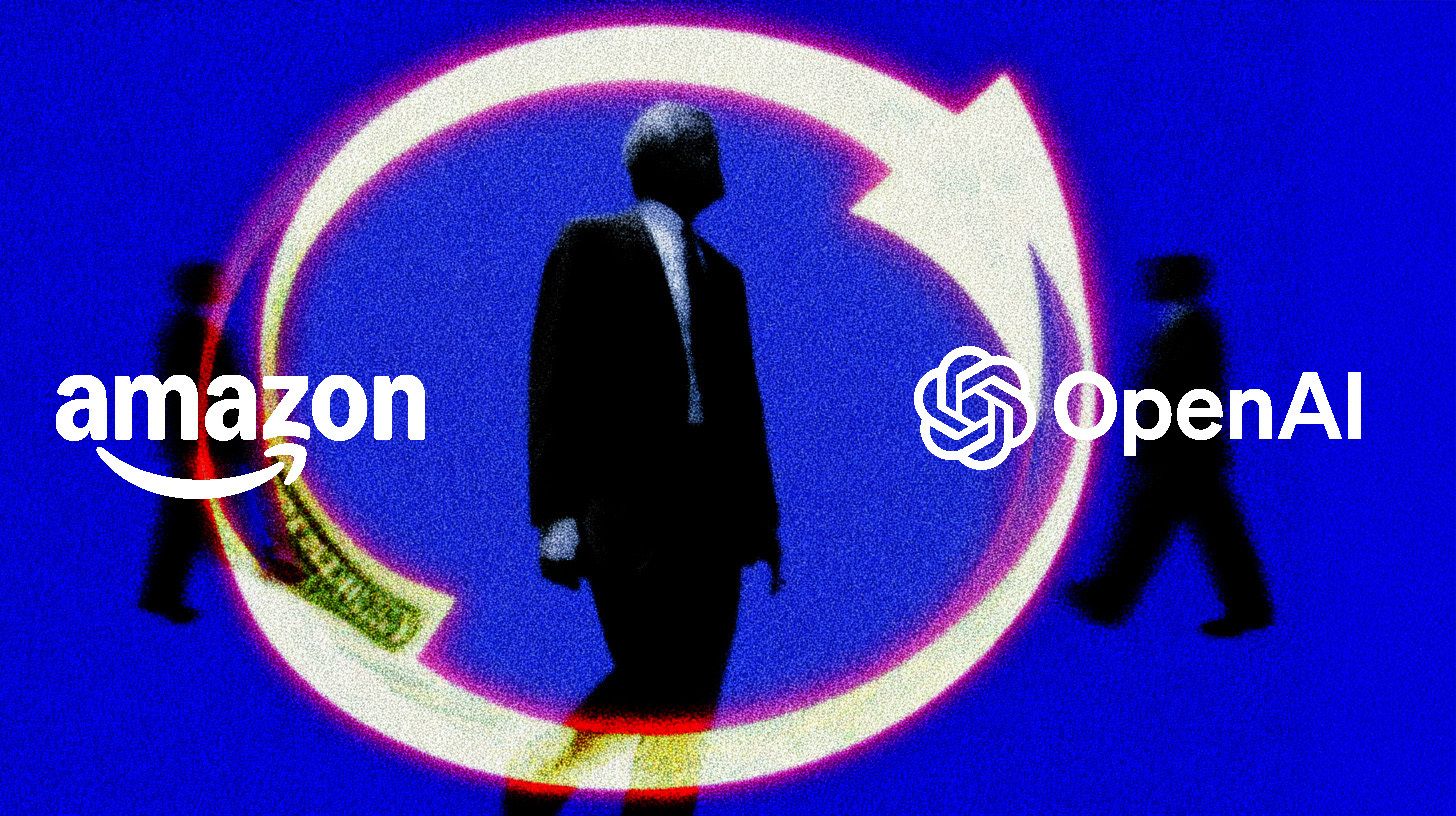
OpenAI is in talks for a $10 billion investment from Amazon, The Information reported. The deal would value OpenAI above $500 billion and could lead the company to use Amazon’s Trainium chips to train its models.
Reporting on the deal once again raised fears about circular deals in the AI world, which could cause dramatic financial damage if AI demand dries up. Still, OpenAI using Trainium chips would be a coup for Amazon, which has been attempting to challenge Nvidia’s AI chipmaking supremacy.
The AI industry has been the subject of some scrutiny over deals that essentially involve one firm investing in another firm that agrees to buy products from the first firm.
For instance, Nvidia invested $100 million in OpenAI to support a data center buildout that would involve OpenAI buying Nvidia chips.
Such deals can accelerate AI labs' ability to secure financing to train models, but critics argue that the interconnectedness of AI companies could lead to a severe crash.
In this case, OpenAI has already made a $38 billion commitment to purchase cloud computing services from Amazon, so Amazon is on the list of debt obligations that OpenAI will be using its fresh $10 billion to meet. The connection between the two companies raised eyebrows from industry watchers.
Others dismissed concerns about the deal.
“This is just good business for Amazon and others. Invest at a lower valuation and ultimately take profits at a higher one while putting money into companies that will consume from your technology and grow the utilization of said technology over time,” The Futurum Group CEO Daniel Newman said.
Circular AI deals are concerning, but a lot of the risk surrounding them is arguably being priced in. CoreWeave, a poster child for the incestuous AI economy, has gotten drubbed by investors over the past few months. What may be more consequential here is OpenAI signaling its increasing willingness to use chips other than Nvidia’s. That’s probably why Amazon’s stock got a bump at market open after the OpenAI deal news broke, while Nvidia dropped.

TOGETHER WITH FUNNEL
Prove your impact. Optimize campaigns with Conversion APIs

The privacy era has broken the flow of truth between your ads and the platforms measuring them, making attribution harder and budgets less effective.
Conversion APIs (CAPI) offer a secure, reliable way to reconnect your conversion data to major ad platforms, keeping insights accurate, compliant, and complete.
In this recorded webinar, you’ll learn why first-party data is now essential and how Funnel’s Data Activation helps you unlock better campaign performance.
What you’ll learn:
✅ Why today’s data landscape doesn’t work without first-party data
✅ How Funnel’s CAPI enables seamless first-party data integration
✅ How to work with CAPI and LinkedIn for stronger B2B optimization
✅ How agency Trickle implemented CAPI to improve results
POLICY
VC a16z leaps into the fray on AI legislation

Venture capital behemoth Andreessen Horowitz — also known as a16z —unveiled a list of nine pillars it hopes to see enacted in US federal AI legislation.
The list was published shortly after President Trump issued an executive order limiting states’ ability to regulate AI, and as former a16z general partner Sriram Krishnan and White House AI and Crypto Czar David Sacks go on a roadshow, warming state GOP leaders to the idea of federal leadership in AI legislation. Andreessen’s position takes a middle ground on the issue, arguing that Congress should “lead” on AI legislation while states also play an important role.
A16z’s nine pillars can be roughly split into three categories:
Reining in AI companies: Punish harmful uses of AI, protect children from AI-related harms, protect against catastrophic cyber and national security risks, establish a national standard for model transparency
Ensuring federal leadership in AI lawmaking: Ensure federal leadership in AI development, while protecting states’ ability to police harmful use of AI
Investing in and adopting AI: Invest in AI talent by supporting workers and educating students, invest in infrastructure: compute, data, and energy; invest in AI research, use AI to modernize government service delivery
One argument a16z returns to throughout the paper is that federal legislative frameworks should focus on protecting competition to bolster "Little Tech," Marc Andreessen’s favorite term for startups.
While a16z’s legislative pillars may prove influential given the venture capital firm’s political clout, any actual legislation may still be a ways away. There is currently no federal AI framework bill working its way through Congress.
Democrats have been swift to criticize the Trump Administration for what they see as an attempt to greatly limit oversight of the AI industry. For Andreessen Horowitz, which is reportedly very active in lobbying Trump on AI, this paper may be an attempt to show that a16z wants to put reasonable limits on AI companies’ power. Still, time matters for Trump and a16z. A “blue wave” in the midterms could make it much more difficult to pass light-touch federal AI legislation.

LINKS

Google launches Gemini 3 Flash and makes it the default model
ChatGPT Image 1.5 earns early praise, but Nano Banana is more realistic
Chinese AI chipmaker MetaX soars 700% in its market debut
Zuckerberg's AI blitzkrieg at Meta is hitting a rough patch
Palantir alums secure funding to use AI to simplify patent filing
Upstart chipmaker Mythic raises $125M to take on Nvidia in AI
Former OpenAI researcher lands at Tencent as chief scientist

Xiaomi MiMo-V2-Flash: A new lightweight foundational language model that excels in reasoning, coding and agentic tasks.
WhatsApp ElevenLabs: ElevenLabs’ agents are now available for deployment on the WhatsApp messaging platform.
Google Labs Gems: New systems that allow you to create interactive mini-apps on your desktop by turning your prompts into tools.
HY World 1.5: A new comprehensive, open source world model framework from Tencent.
Hex Notebook Agent: Interactive analysis, organized projects and debugging all in one agent.



A QUICK POLL BEFORE YOU GO
Whose perspective do you trust more on AGI: Demis Hassibis or Yann LeCunn? |
The Deep View is written by Nat Rubio-Licht, Jack Kubinec, Jason Hiner, Faris Kojok and The Deep View crew. Please reply with any feedback.
Thanks for reading today’s edition of The Deep View! We’ll see you in the next one.

“The texture and blur in the background of the AI image are not quite right.” |

“[The] fact that there really is a book by that title fooled me. The reflections out the window didn't, though.” |


Take The Deep View with you on the go! We’ve got exclusive, in-depth interviews for you on The Deep View: Conversations podcast every Tuesday morning.

If you want to get in front of an audience of 450,000+ developers, business leaders and tech enthusiasts, get in touch with us here.