- The Deep View
- Posts
- New report contradicts AI job fears
New report contradicts AI job fears

The Deep View
December 19, 2025


Welcome back. Anthropic recently teamed up with AI safety firm Andon Labs on Project Vend, which put an AI agent “Claudius” in charge of a vending business — a stocked refrigerator, some snack baskets on top, and an iPad for self-checkout. Employees at Anthropic could message the vending machine on Slack to order products. Claudius did some things well, especially supplier management, adapting to user demands, and identifying scams. But it also failed in other ways, such as not managing inventory properly, selling products at a loss, and hallucinating key details. The company concluded, "If Anthropic were deciding today to expand into the in-office vending market, we would not hire Claudius… However, at least for most of the ways it failed, we think there are clear paths to improvement." Read the full report to see how close you think AI agents are to doing this kind of work. —Jack Kubinec and Jason Hiner
1. New report contradicts AI job fears
2. ChatGPT apps are buggy, but live and ready to try
3. OpenAI's unlikely new ally: Universities
RESEARCH
New report contradicts AI job fears

Fears that AI is stealing jobs has been one of the strongest trends of 2025, but there's new evidence trying to debunk that popular narrative.
According to a recent report from Vanguard, wage and job growth has increased over the past two years in roles that are exposed to AI, compared to those that aren’t. Vanguard measured the growth rate for roles and wages for the top 100 occupations most exposed to AI, and found that annualized growth of jobs saw a 1.7% increase per year since 2019, while annualized “real” wages saw a growth rate of 3.8%. Comparatively, all other occupations saw an annualized growth rate in jobs of 0.8%, and an annualized “real” wage increase of 0.7% in the same time period.
The report found that AI systems are enhancing these workers’ productivity, opening them up to higher-value work.
Vanguard's findings sit in stark contrast to broad fears that AI is decimating the job market. While this report may assuage some of those concerns, all it’s saying is that AI hasn’t come to replace workers yet. Several other reports, however, find that the impact could be dire:
MIT and Oak Ridge National Laboratory found that AI is already capable of replacing 11.7% of jobs and eating up $1.2 trillion in wages.
McKinsey, meanwhile, found that AI and robotics could automate activities that take up 57% of US work hours.
And the fear of this looming shadow could be impacting workforce morale: A Pew study found that more than half of workers surveyed – around 52% – were worried about AI’s impact on the workplace, with 32% fearing fewer job opportunities in the long term. A third of employees surveyed reported feeling overwhelmed by the tech.

While most organizations aren’t firing large swathes of people to replace them with AI agents at this stage, the tech is altering how people work. Large numbers of people are currently figuring out how to integrate AI into their day-to-day jobs, leading employers to invest in reskilling. But not everyone is receptive to this new way of work, and not every role can be reskilled. In October, Accenture let go of 11,000 workers who couldn’t be retrained on AI. What happens to those who can't be reskilled? These workers are largely left out of the rosy AI picture that tech firms are painting of the future. Some, such as Google CEO Sundar Pichai, are emphasizing that workers will have to adapt to the ways AI will change the job market.

TOGETHER WITH ROCKET
Build an App from Your Pocket

Meet Rocket Mobile—the full power of Rocket.new, now on iOS.
Whether you're commuting, between meetings, or in line for coffee, you can create, edit, and deploy full-stack apps from your phone. From fixing a bug to shipping a new feature in seconds, Rocket Mobile turns idle moments into progress.
Built with Face ID security, one-tap actions, and a mobile-first UI, it's redefining what’s possible on the go. No laptop required.
HOW TO AI
Have you been enjoying the "how to AI" section?This week we've been testing a section where we breakdown how to use AI in 5 mins. Let us know your thoughts! |
BIG TECH
ChatGPT apps are buggy but live and ready to try

ChatGPT's app directory, which lets users interact with external apps directly within OpenAI's popular chatbot, is now live.
The store launched with several dozen apps that users can activate in ChatGPT’s main interface by pressing the “@” key. OpenAI also opened up app submissions from developers.
While ChatGPT has long offered a GPT store where users can browse custom versions of ChatGPT, the app directory lets third-party apps integrate with the chatbot itself. Featured apps at launch included Adobe Photoshop, Instacart, and Spotify, which let users edit photos, put together a grocery list, or make a playlist — at least in theory. As I poked around the app store, I encountered multiple bugs in apps that caused them not to work as intended.
However, Spotify’s custom playlist option worked well. Here’s an example:
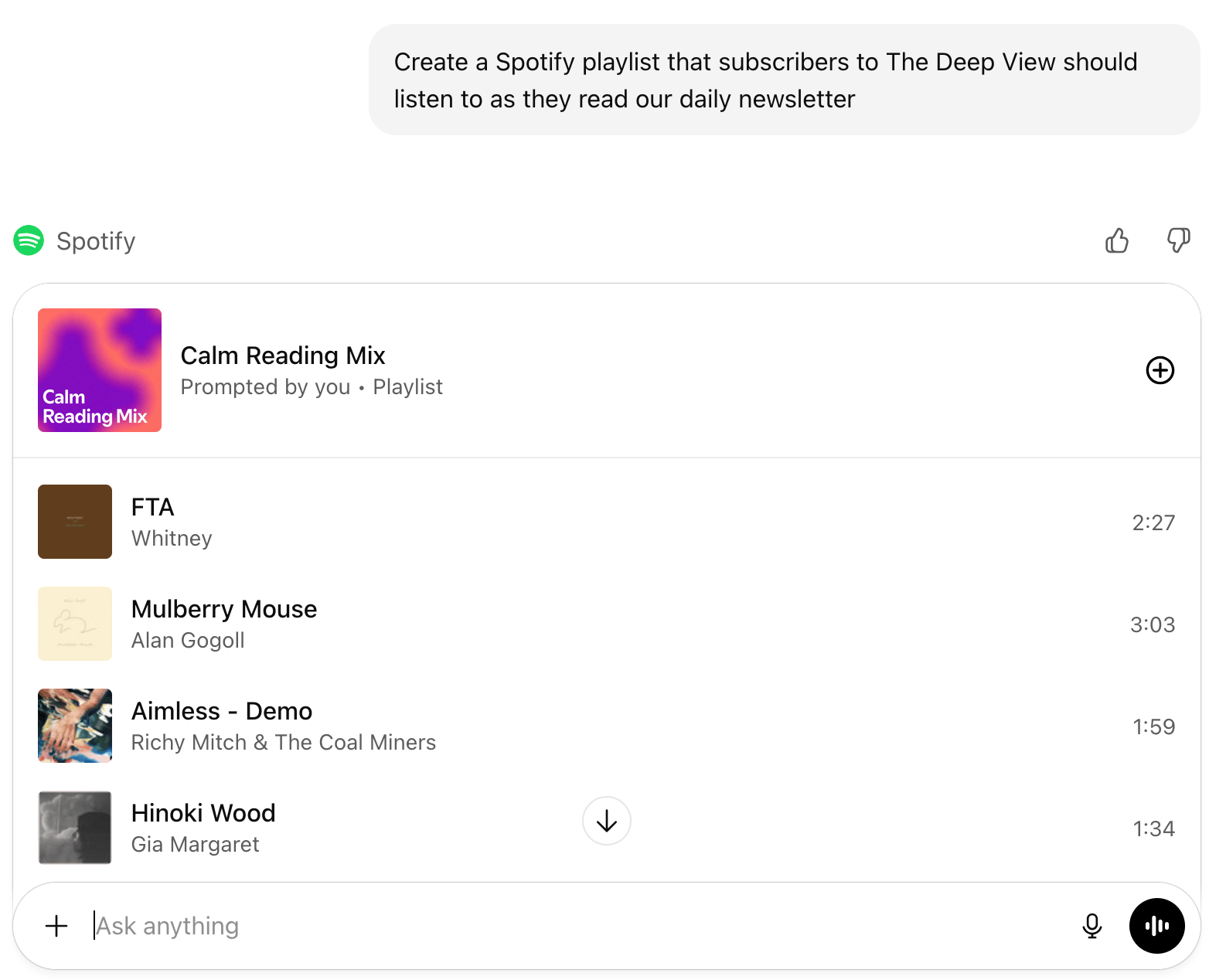
The move is OpenAI’s latest in a series of products shipped since the company declared a “code red” in early December, in response to the positive consumer reception to Google’s Gemini 3.
If rolled out successfully, ChatGPT’s app store will be a major boon to OpenAI. As Ben Thompson notes in his aggregation theory, the winners in the internet age are businesses that own the relationship with the end consumer. To meet its lofty business expectations, OpenAI needs users to rely on ChatGPT for more and more of their internet tasks. If users can order groceries, put on music, make weekend plans, and get various kinds of work done all within ChatGPT, then the company's eye-watering $750B valuation looks a little less wobbly.

TOGETHER WITH ASAPP
Give every customer a personal AI agent

We're ready to unveil how ASAPP Customer Experience Platform makes every customer feel like a VIP by uniting your systems, data, workflows, and teams, so you can finally serve customers intelligently, not reactively.
Join us for a free webinar to see what ASAPP CXP means for you:
One platform to serve your customers
Lower cost to serve without lower quality service
AI that understands, speaks naturally, and resolves issues
Easy integrations with your tools—no rip and replace
Happier, more loyal customers
CULTURE
OpenAI's unlikely new ally: Universities

As students use ChatGPT to write their college papers to the chagrin of their professors, OpenAI wants to make its relationship with universities more official.
The company is forging relationships with colleges around the country, having sold more than 700,000 ChatGPT licenses to 35 public universities, according to Bloomberg. Students and faculty across 20 campuses used the chatbot more than 14 million times in September, the outlet reported, averaging around 176 uses per month across tasks.
These deals aren’t the only sign that OpenAI has its eyes on the classroom.
In November, the company launched a free version of ChatGPT built for K-12 teachers through June 2027, including admin controls for school and district leaders. And teachers are making use of the tech, with around 60% of teachers using some sort of AI tool for their work, according to Gallup.
On the student side, ChatGPT introduced “study mode” in July, a tool that guides students through challenging homework problems collaboratively rather than just giving them the answers directly.
But whether these schools and universities sanction it or not, students will lean on AI. A Copyleaks report found that 90% of the roughly 1,100 college students surveyed are using AI academically. And even if the tech is prohibited, AI detection tech is shoddy at best, with false positives and false negatives often gumming up the works.
In partnering with OpenAI and other AI firms, these educators are taking control of something that was otherwise happening right under their noses. Strict, outright bans on the technology will just force students to come up with new and creative ways to cheat. Instead, that control could allow educators to guide students in responsible AI use, leveraging it as a tool rather than a system that does most of the thinking for them. This could also prevent AI overuse, skirting concerns that AI is eroding critical thinking in young and impressionable minds.
LINKS

AI may use as much water as water bottles globally, but author Karen Hao issued corrections to her reporting on data center water use.
The FTC is investigating Instacart’s AI pricing tool.
World model startup General Intuition is raising at over a $2 billion valuation.
Ex-Meta AI boss Yann Lecun wants his startup to be valued at €3 billion.
Lovable raised $330 million at a $6.6 billion valuation.

GPT-5.2-Codex: OpenAI’s newest agentic coding model
Agent Skills: Anthropic released its packaged instructions technology as an open standard.
Manus: Edit slides created with Nano Banana Pro.
Capsules: Turn essays or posts into animated microsites.

Forward Deployed Engineers embed where decisions happen, translating business priorities into shipped product faster than traditional engineering teams.
While others debate timelines and chase alignment, smart companies deploy engineers who unblock work, accelerate delivery, and reduce iteration cycles.
At Athyna, we provide senior Forward Deployed Engineers who integrate directly into your team:
Modern tech stack expertise — engineers experienced in Python, TypeScript, React, Node.js, AWS, Kubernetes, Terraform, and more.
AI-powered matching finds engineers aligned to your stack and use case.
4 days from brief to interviews—no hiring drag, no bottlenecks.
Save up to $80K per hire vs. U.S. talent without compromising seniority or impact.


POLL RESULTS
Whose perspective do you trust more on AGI: Demis Hassabis or Yann LeCun?
Demis Hassabis (35%)
Yann LeCun (43%)
Other (22%)
The Deep View is written by Nat Rubio-Licht, Jack Kubinec, Jason Hiner, Faris Kojok and The Deep View crew. Please reply with any feedback.
Thanks for reading today’s edition of The Deep View! We’ll see you in the next one.

“It came down to the fingers and finger nails, they looked realistic in [this image], which is not usually the case with AI-generated images.” |

“Unrealistic helmet in the [other image]” |


Take The Deep View with you on the go! We’ve got exclusive, in-depth interviews for you on The Deep View: Conversations podcast every Tuesday morning.

If you want to get in front of an audience of 450,000+ developers, business leaders and tech enthusiasts, get in touch with us here.