- The Deep View
- Posts
- Nvidia bets on Murati’s frontier AI startup
Nvidia bets on Murati’s frontier AI startup

The Deep View
March 11, 2026

Welcome back. World models continue to accelerate as the next frontier in AI. Yann LeCun’s new startup, AMI Labs, just raised a $1 billion seed round to build systems that understand and interact with the real world. And you heard that right, it's a $1B "seed" round. Let that sink in. Google is pushing Gemini deeper into everyday work with new AI features across Docs, Sheets, Slides, and Drive. And Nvidia is placing a strategic bet on Mira Murati’s Thinking Machines, pairing a major investment with plans to deploy massive Vera Rubin systems. Nvidia loves a frontier lab because they always demand the most cutting-edge chips. —Jason Hiner
1. Nvidia bets on Murati’s frontier AI startup
2. Google upgrades AI inside Docs and Sheets
3. World models accelerate with $1B bet on LeCun
STARTUPS
Nvidia bets on Murati’s frontier AI startup
Nvidia is giving Thinking Machines a much-needed hand.
On Tuesday, the chip giant and the nascent AI lab announced a multiyear strategic partnership, in which Thinking Machines will deploy at least a gigawatt of Nvidia’s Vera Rubin systems to build its models and platforms, starting next year. The startup will also develop training and inference systems for Nvidia architecture.
In addition, Nvidia has made a “significant investment” in the lab to support its growth. Although no numbers were released, Thinking Machines has a valuation of more than $12 billion and has raked in $2 billion in funding since its inception. In November, the company was reportedly seeking to raise another $5 billion at a $50 billion valuation.
“Thinking Machines has brought together a world-class team to advance the frontier of AI,” Nvidia CEO Jensen Huang said in the press release. “We are thrilled to partner with Thinking Machines to realize their exciting vision for the future.”
Nvidia’s support follows a turbulent time for Thinking Machines. The company, which is just over a year old, has faced departures of several key employees in recent months:
In January, the Thinking Machines CEO and OpenAI alum Mira Murati reportedly fired CTO and co-founder Barret Zoph for “poor performance and talking to competitors,” according to The Information. Murati installed Soumith Chintala, co-creator of deep learning framework PyTorch, as the company’s CTO.
Following that move, four other employees have tendered their resignations, with several of them leaving for OpenAI. Prior to this, Andrew Tulloch, another co-founder of the company, departed for Meta in October.
"Nvidia increasingly acts as both capital provider and capacity allocator to frontier labs, ensuring its most advanced architectures have guaranteed, long-duration demand," Forrester Senior Analyst Alvin Nguyen told The Deep View. "This is not a bet on Thinking Machines’ current products. It’s a bet on optionality, compute leverage, and strategic positioning in a capital‑constrained AI future."

It’s a smart move for Nvidia to embed itself with Thinking Machines. The startup is extremely nascent, having only launched one product, a language model fine-tuning platform called Tinker, since its inception. If it skyrockets, Nvidia is the foundation that it leaps from and likely gains a long-term strategic partner. Frontier models are Nvidia's best customers since they demand the latest and most powerful GPUs, so it is very incentivized to help more frontier labs to flourish. However, valuations for these young AI companies are only getting bigger, with firms less than a few years old raking in billions in early-stage funding. The question remains how realistic the expectations are of early companies like Thinking Machines, especially as departures from the firm cast a shadow. That makes the move a high-risk, high-reward situation for Nvidia.

TOGETHER WITH MIDORI BIO
This Tech Solves the $600B Plastic Industry's Biggest Problem

With 380M tons of plastic produced every year, regulators are forcing manufacturers to solve plastic waste. Retooling factories costs billions. Alternative materials require complete supply chain overhauls.
Midori Bio has the answer. Their additive accelerates plastic decomposition 64X without requiring factories to change anything. It produces the same results across verticals like sports packaging, footwear, grocery. No capital investment or operational disruption needed.
Major customers like Planters Peanuts and HEAD/Penn Tennis are already on board. 150+ new potential partners are currently in discussion.
Brands are moving fast because they need to adapt, and Midori has a ready-made solution. Become an early-stage Midori investor at $1/share before their share price changes tomorrow night.
PRODUCTS
Google upgrades AI inside Docs and Sheets

Google Workspace's tools are already productivity cornerstones for nearly 3 billion users, and new Gemini features aim to give users an AI-shaped boost.
On Tuesday, Google updated Docs, Sheets, Slides, and Drive with deeper Gemini integrations to help users create content across apps more easily. For instance, the new Help Me Create feature in Google Docs analyzes content across Drive, Gmail, Chat, and the web to generate fully formatted first drafts.
Other new Google Docs features include a co-editor, which can now refine whole sections of your document, including matching the document’s writing style for consistency in tone and voice. Gemini can now also help users match the style and structure of reference documents, making it easier to repurpose old documents.
While the Doc updates will likely be what impacts the largest number of Google Workspace users, the other upgrades help with everyday tedious tasks such as creating spreadsheets or presentations, or sifting through all your content:
Google Sheets: Gemini can now help build entire spreadsheets from a prompt as well as data from Gmail, Chat, and Drive, fill in data from simple descriptions (instead of complex formulas), and solve “advanced optimization problems.”
Google Slides: Gemini can create slides that are on theme and pull from your files, email, and the web, and can also edit slides.
Google Drive: Users can now view AI Overviews when they search their Drive using conversational prompts, and have multi-turn conversations with Drive based on the content of documents, emails, calendar, and the web.
All of these features are rolling out to Google AI Pro & Ultra subscribers. The Google Docs and Slides features are rolling out to Gemini Alpha business customers globally, whose default language is US-English only, while the Drive features are coming to Gemini Alpha business customersin the US, starting with US-English only.
Google's biggest advantage in the AI race is the popularity of its products, which are already used by billions of people, making Gemini features widely accessible. Google's AI Overviews is the clearest example, boasting over 2 billion monthly users as of July, driven by Google's dominance in search and by the feature's helpfulness and ease of access. This new batch of Workspace updates accomplishes the same thing: it provides shortcuts in people's everyday activities in a place they already use, saving them the step of manually going to ChatGPT or Claude. Of course, the features are limited to higher-tier subscribers for now, but they could roll out more broadly over time.

TOGETHER WITH ASSEMBLYAI
Your users notice every word your app gets wrong.
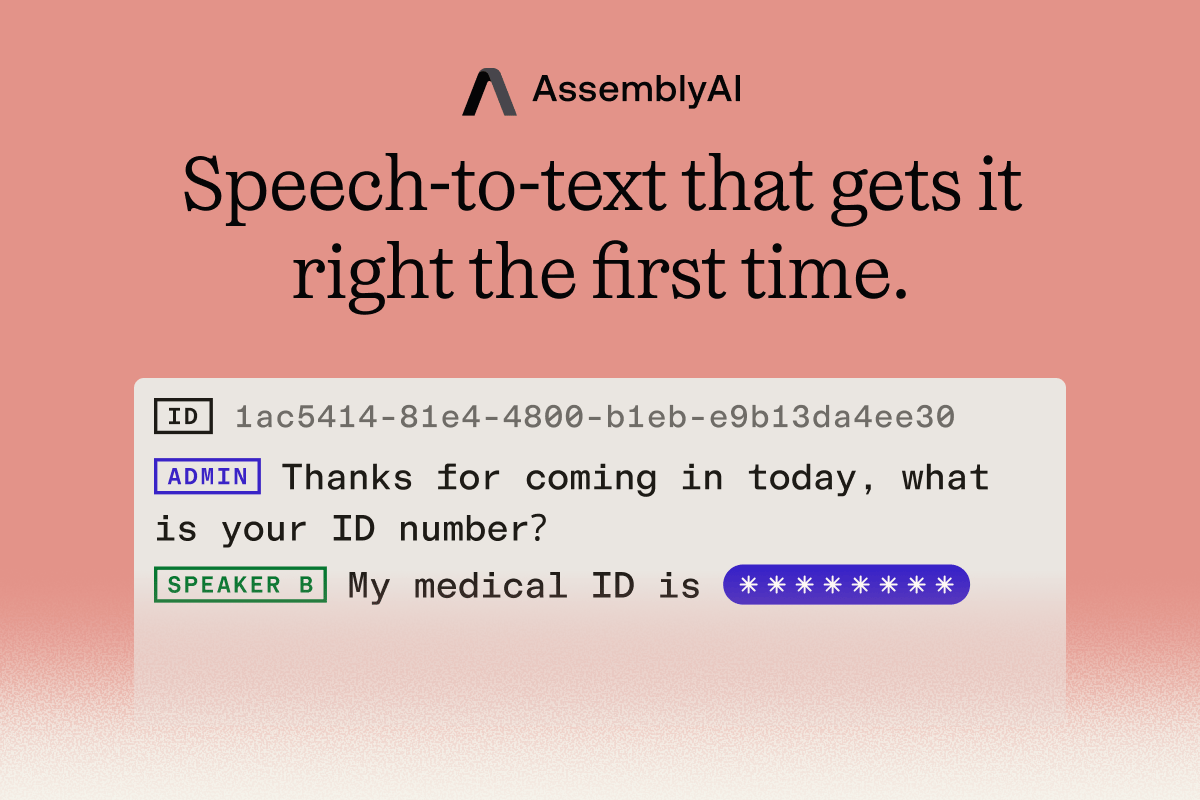
Transcript errors are serious business. Whether it's a misspelled name or missing words, working with voice means everything depends on the accuracy of your transcription. If Speech AI is one of the first layers of your AI system, you must trust it to be as accurate as possible.
AssemblyAI gives builders the most accurate speech AI on the market:
High accuracy transcription on noisy, accented, and multilingual audio
Flexible, usage-based pricing that scales without commitments
Speaker labels built for batch audio and real-time streaming
Trusted by teams at Calabrio, Granola, Cleo Health, and thousands more. Start for free with $50 in credits →
RESEARCH
World models accelerate with $1B bet on LeCun

Another world model startup has come out of the gate swinging.
On Tuesday, Advanced Machine Intelligence, a startup founded by former Meta Chief Scientist and AI godfather Yann LeCun, announced a more than $1 billion seed funding round at a $3.5 billion pre-money valuation, the largest seed funding round in Europe to date. The round included marquee investors such as Greycroft, Jeff Bezos-owned Bezos Expeditions, Nvidia, Mark Cuban and former Google CEO Eric Schmidt.
Along with the funding, the company announced its talent line-up, several of whom come from Meta. The team includes:
Alexandre LeBrun, a former Meta AI engineer and founder of healthcare AI firm Nabla, as CEO, Laurent Solly, Meta’s former VP of Europe, as COO, Pascale Fung, former Meta responsible AI consultant, as chief research and innovation Officer, and Michael Rabbat, former research science director at Meta, as VP of world models.
The founding team also includes Saining Xie, former Google DeepMind research scientist on the Nano Banana team and a leading researcher in visual representation learning, as chief science officer.
In the announcement, AMI Labs said its mission is to build AI systems that understand reality and can operate reliably and safely in the real world, a key hurdle in advancing physical AI and robotics. It fits squarely into LeCun’s long-held belief that AI must go beyond large language models to achieve a human-level understanding of the world.
“As AI begins to move beyond screens, intelligence must go beyond simply producing outputs,” the company said in its press release. “It must understand situations, retain context, anticipate consequences, and act reliably over time.”
AMI Labs’ fundraising round also underscores the growing hype around world models, or AI systems capable of understanding and acting upon the world around us. In mid-February, Fei-Fei Li’s World Labs raised $1 billion at a $5 billion valuation, with a mission to “advance spatial intelligence by building world models.” And Runway, a video AI startup, raised $315 million in Series E funding at a $5.3 billion valuation, calling world models the “most transformative technology of our time.”
The excitement around world models and physical AI right now is akin to the buzz around LLMs in 2022, gaining traction among investors and attracting talent from big AI labs like Meta and Google. And when things like this are shiny and new, the inclination is to move fast. The problem, however, is that these models are hard to build and even harder to deploy. Additionally, the stakes are high in getting it right: Because these models aim to be the catalyst for physical AI systems, their mistakes have physical consequences. As such, these developers are caught between the desire to build quickly and the necessity to build carefully. So think of world models as a longer-term bet for now.
LINKS

Meta acquires AI agent social media platform Moltbook
Amazon wins court order to cut out Perplexity’s shopping bots
Thousands of writers publish empty book to protest AI
Metadata firm Gracenote is suing OpenAI for copyright infringement
Niantic, Coco partner to use Pokémon Go training maps on delivery bots
US Senate approved to use ChatGPT, Gemini and Copilot for work
Anthropic to open an office in Sydney, Australia
Microsoft supports Anthropic, calls for a temporary restraining order
ChatGPT rolls out visual explanations to help understand math and science

Gemini Embedding 2: Google’s first multimodal embedding model built on Gemini, mapping maps text, images, videos, audio and documents in a unified space.
Chronicle 2.0: Use AI to create your presentations, without the slop. Designed for sales proposals, pitch decks, research reports and more.
Spine Swarm: Deploy swarms of AI agents for tasks such as web browsing, research, document or presentation generation and prototype development, with just a prompt.
Vozo Visual Translate: Translates everything in a video, including voice dubbing, lip-syncing, subtitles and on-screen text.



A QUICK POLL BEFORE YOU GO
Have you tried Anthropic's Claude for the first time in the past two weeks? |
The Deep View is written by Nat Rubio-Licht, Sabrina Ortiz, Jason Hiner, Faris Kojok and The Deep View crew. Please reply with any feedback.

Thanks for reading today’s edition of The Deep View! We’ll see you in the next one.

“Haziness in upper background and a different coloration. Plus, it looked dirtier. I've been to those types of locations and this looked more like ones I had seen all over the world!” “The animals had more scars and details that make them unique rather than idealized.” “AI would never make such a haphazard composition.” |

“English language signage in [this image] is a giveaway, so too the ideal lighting across foreground, middle ground and background. Also, composition is too staged.” “There's a font choice that AI makes frequently that can be seen on the signs in the background.” “[This image] is the fake image because the motorcycles have the lights on when it is daytime.” |


Take The Deep View with you on the go! We’ve got exclusive, in-depth interviews for you on The Deep View: Conversations podcast every Tuesday morning.

If you want to get in front of an audience of 750,000+ developers, business leaders and tech enthusiasts, get in touch with us here.
*indicates sponsored content
*Midori Bio Disclaimer: This is a paid advertisement for Midorio Bio's Regulation A offering. Please read the offering circular at https://invest.midori-bio.com/