- The Deep View
- Posts
- Nvidia wants to fill AI's open-source gap
Nvidia wants to fill AI's open-source gap

The Deep View
December 16, 2025

Welcome back. If you've tried Google's Nano Banana Pro for creating AI-generated images in Gemini, then you've probably been impressed by how much more realistic the images are compared to earlier versions of tools like DALL-E and Midjourney. What's surprising is that the new AI image generators are looking more real by being more imperfect, as The Verge aptly put it. Specifically, it's making AI-generated images look more like our flawed phone photos, so you can no longer spot them by how smooth and perfect they look. That makes it even more critical for the industry to adopt C2PA watermarks. And of course, if you want to test your skills at spotting AI images, you can take our AI-or-Not challenge every day at the bottom of the newsletter. — Jason Hiner
1. Nvidia wants to fill AI's open-source gap
2. VC in AI is getting extremely top-heavy
3. US govt unveils AI talent magnets — good luck
OPEN SOURCE
Nvidia wants to fill AI's open-source gap

As Meta backs away from open source AI, Nvidia is stepping up.
On Monday, the chip giant debuted the latest version of Nemotron 3, its family of open frontier models. These models are targeted specifically at building agentic applications with more accuracy and efficiency.
Nemotron 3 comes in three sizes: 30 billion parameter Nano, 100 billion parameter Super, and 500 billion parameter Ultra. While Nano is available now, Ultra and Super will come to the market in the first half of 2026.
The models’ design offers 4x higher token throughput with 60% lower reasoning token generation than previous designs, which Nvidia claims is “significantly lowering inference costs.”
Along with the models themselves, the company released a set of open source tools, including training ecosystems, datasets and an evaluator for safety and performance.
By the common definition set by the Open Source Initiative (or OSI), “Nemotron is close to being an open-source LLM,” Steven Vaughan-Nichols, open-source journalist and analyst, told The Deep View. “It's only problem, from where I sit, is its license, the NVIDIA Open Models License, while much closer to being a true open-source license than say Meta's bogus open-source license, Llama license, isn't OSI-blessed."
Nvidia’s models offer another family of options to the open source ecosystem in the US at a time when the choices might be looking slimmer. Despite its long-time dedication to making open source AI, Meta is reportedly weighing making its next model, codenamed Avocado, proprietary.
As it stands, Meta is one of the primary providers of open-source models in the US. China is largely ahead of the US in the open source market. With models from DeepSeek, Alibaba and Baidu performing on par with proprietary frontier models in the US, many startups in Silicon Valley are leveraging Chinese AI over US counterparts.
Along with marking a complete 180-degree turnaround in Meta’s AI approach (likely as it seeks to make more money from its models), abandoning its open-source efforts would limit the US-native options available to open-source developers at a time when the pickings are already somewhat slim.

Though open-source technology is vital to creating a landscape of collaborative innovation, cash flow has long been a problem for this development framework. Given its place as the world’s most valuable company, Nvidia is likely infusing the open-source market because it can afford to. And Nvidia stands to gain in more ways than one: Along with the “good guy” card that comes with feeding a hungry ecosystem, Nvidia is getting more developers hooked into its CUDA technology platform, and, in turn, creating more customers for its chip business.

TOGETHER WITH ROCKET
Build an App from Your Pocket

Meet Rocket Mobile—the full power of Rocket.new, now on iOS.
Whether you're commuting, between meetings, or in line for coffee, you can create, edit, and deploy full-stack apps from your phone. From fixing a bug to shipping a new feature in seconds, Rocket Mobile turns idle moments into progress.
Built with Face ID security, one-tap actions, and a mobile-first UI, it's redefining what’s possible on the go. No laptop required.
MARKETS
VC in AI is getting extremely top-heavy

Today's AI boom is all about scale, and AI-focused venture capital is no exception.
Big VC firms are raising a larger proportion of overall funds to bet on an increasingly narrow set of AI companies. Despite the consolidation, the overall venture capital being deployed into AI has grown quite large — surpassing even an exuberant 2021.
In venture capital, it pays to be big these days. Just 12 VC firms raised over 50% of all venture funds in the first half of 2025, per Pitchbook. And while venture capital has reportedly been difficult to raise in recent months, some larger funds are bucking the trend.
Two new AI-focused megafunds were disclosed Monday. Lightspeed Venture Partners raised “more than $9 billion” for an AI-focused fund, The New York Times reported. Lightspeed has already invested in Anthropic, xAI, and Mistral, which carry a collective valuation of over $400 billion. Then Axios scooped that Dragoneer, which has plowed more than $3 billion into OpenAI, raised a new $4.3 billion fund.
Mirroring the trend in venture fundraising, venture capital dollars are being deployed into a more concentrated group of startups. In August, Pitchbook said that 41% of all venture dollars for the year had gone into just ten startups. OpenAI alone made up for 20% of all yearly VC deployment at the time. In 2021, the top ten companies only brought in 6% of overall venture capital.
“Every VC I talk to agrees that we are either in, or building towards an AI bubble. Still, the common belief, which I tend to agree with, is that the winning companies being built through this period are going to have such wildly large outcomes that you need to be in [the] market trying to get targeted exposure to the winners. I think I have talked to one fund that has truly sat out from AI deals over the past 365 days. The idea here is that if you were in eBay or Google during the dotcom crash, you probably felt ok. Whether you call it hubris or something else, our job as VCs is to find those outliers that endure and generate huge outcomes regardless of a crash,” Sam Lehman, junior partner at Pantera Capital, said.
AI is making an outsized contribution to equity markets, so it’s no surprise to see it do the same in venture capital. While many investors rush to invest directly in top AI labs, Lightspeed’s investors get indirect exposure to Anthropic, xAI, and Mistral. The era of founders raising money from dozens of funds for far-fetched startup ideas may be over, but venture capital itself is still going strong in the AI era.

TOGETHER WITH AMAZON
Build reliable automations at scale with Amazon Nova Act
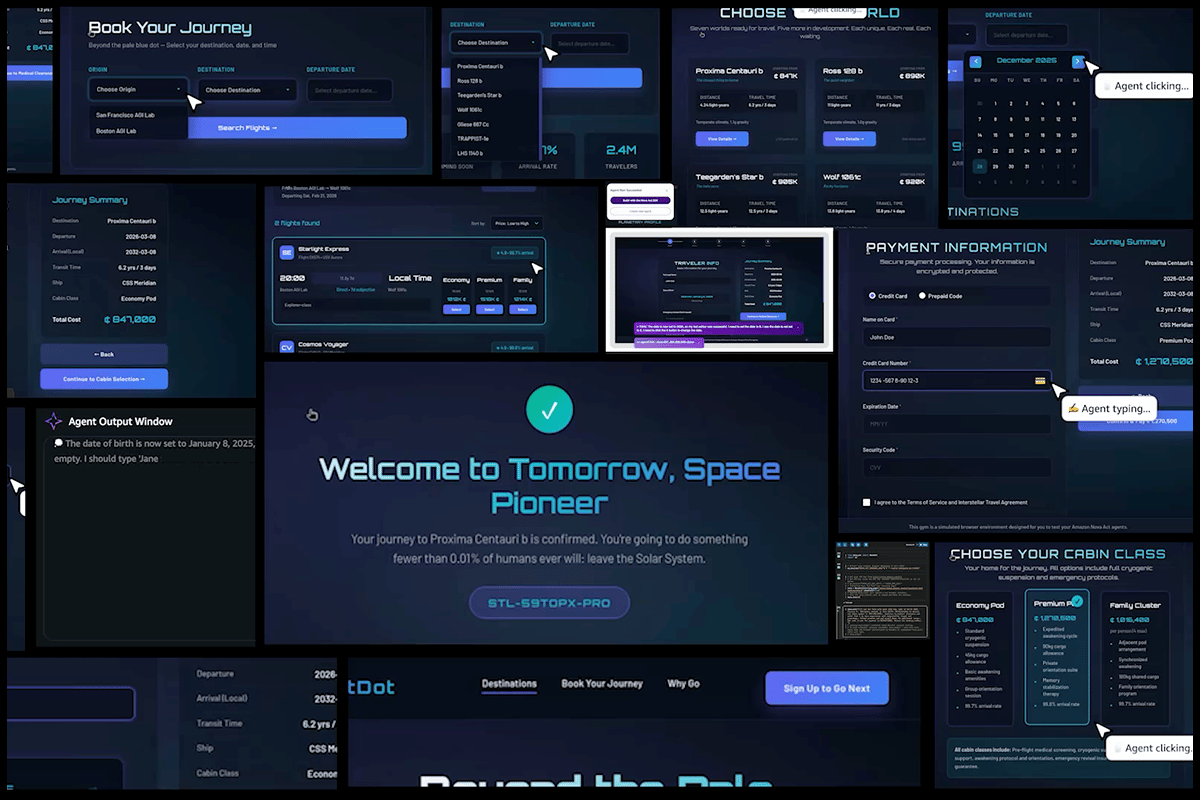
Meet Nova Act, where you can build, deploy, manage, and streamline UI workflows through #NormcoreAgents.
#NormcoreAgents automate repetitive tasks at scale…
✅ Filling address fields
✅ Toggling feature flags
✅ Uploading avatars
…so that you can orchestrate complex web flows with precision.
Unlike traditional models trained in isolation, these agents are trained in dynamic “gym” environments that mirror real UI conditions where they can experiment, fail, and learn, without breaking anything!
The result? An adaptive, high-completion agent that works at scale so you can automate repetitive tasks and focus your time on building what matters.
Give Nova Act a try in the playground and start building your own #NormcoreAgents.
OPERATOR’S MANUAL
Turn any document into an AI podcast you can talk to


NotebookLM is Google's sleeper hit. It’s an AI research assistant that only answers questions based on documents you upload. No hallucinations, always cites sources. Upload a PDF (or many), click one button, and two AI hosts have a full podcast conversation about it. Then you can join the conversation and ask them questions in real time.
How to do it:
Go to notebooklm.google.com, sign in with Google, and click Create. Name your notebook.
Add your sources. NotebookLM accepts PDFs, Google Docs, Slides, web URLs, YouTube links (it pulls the transcript), and audio files. Drag in up to 50 sources per notebook.
In the Studio panel on the right, click Audio Overview. Before generating, hit the small Customize (pencil icon) to pick your format:
Deep Dive — Full 10-20 min conversation (default)
Brief — Quick 5 min overview
Critique — Constructive feedback on your work
Debate — Two sides argue the topic
Optional: Add custom instructions like "Focus on practical applications" or "Explain technical terms simply." Then hit Generate. Takes 2-3 minutes.
Once ready, enable Interactive Mode and click Join. You can now ask the AI hosts questions mid-conversation — they'll pause, answer based on your sources, then continue. Download the MP3 when done.
Download the MP3 for offline listening, or share the link with your team.
WORKFORCE
US govt unveils AI talent magnets — good luck

If the public and private sectors have one thing in common right now, it’s that they’re both itching for more AI talent.
The Trump Administration has launched several efforts to bolster the federal government's AI talent. On Monday, the administration announced the United States Tech Force, a unit aimed at recruiting 1,000 tech workers to serve at agencies for temporary, two-year posts.
The initiative is primarily aimed at early-career software engineers, data scientists and technologists. The administration is also recruiting for higher-level and management roles for leaders on leave of absence from their companies, allowing them to retain their stock options.
The initiative will partner with around two dozen tech companies, including Meta, Oracle and xAI, to provide career development expertise and a job fair once the recruits complete their term, Scott Kupor, the director of the office of personnel management, told CNBC. The salaries for these roles will range from $150,000 to $200,000 annually. AI engineers can make twice that (or higher) at companies like OpenAI, Anthropic, and other AI leaders.
“The message we’re going to bring to people is a fantastic message,” Kupor said. “Do you want to do good for the country, and also do you want to advance your career?”
The initiative follows a bill introduced in Congress on Wednesday called the AI Talent Act, which aims to help the federal government recruit and retain top tech talent. The bipartisan bill would create teams within agencies dedicated to sourcing talent, with the first statute being to develop talent pipelines.
While these initiatives underscore that the US government is eager to bring on more tech workers focused on AI, it’s unclear how successful they’ll be at drawing talent away from the loving arms (and sky-high compensation packages) of the private sector. AI is practically being developed in dog years, with breakthroughs happening at the speed of light. A lot can develop right now during the span of a two-year hiatus. US government initiatives, meanwhile, haven’t traditionally advanced rapidly. Coaxing a bright young engineer away from the glamour of Silicon Valley could prove a very difficult task, beyond the compensation difference.
LINKS

Palantir CIO Jim Siders to join Thrive Capital’s IT services business
OpenAI hires former Google exec for M&A, Shopify exec for ChatGPT app
Disney, OpenAI Sora deal reportedly based entirely in stock
Lidar firm Luminar files Chapter 11 bankruptcy
Ford is starting a battery storage business for data centers, the grid
Nvidia acquires SchedMD, an open-source workload management provider

Gemini Enterprise Research Agent: Go deeper queries and get comprehensive reports on your internal data and external intelligence.
ChatGPT Branched Chats: Go on a tangent with ChatGPT, now available on iOS and Android.
Orchids: A seamless, multiplayer AI app builder, available on desktop.
Sennu AI: An AI code reviewer from Salesforce, reviewing pull requests and catching issues earlier in development.



A QUICK POLL BEFORE YOU GO
Should US states be able to regulate AI individually? |
The Deep View is written by Nat Rubio-Licht, Jack Kubinec, Jason Hiner, Faris Kojok and The Deep View crew. Please reply with any feedback.

Thanks for reading today’s edition of The Deep View! We’ll see you in the next one.

“The guy in the green shirt in [the other image] is facing the wrong way in the booth.” “Misshapen faces, irregular light fittings, and irregularly-shaped text in the exit sign in the fake image.” “It looks so fake that it had to be the real one.” |

“Didn't think the reflections looked quite right on [the other image]; damned angles got me again.” “The photo on the right has half a booth placed directly in front of a door, which doesn't make sense.” “Weird, there does not seem to be enough room in the booth in front of the door in [the other image]. This booth is unrealistic to me.” |


Take The Deep View with you on the go! We’ve got exclusive, in-depth interviews for you on The Deep View: Conversations podcast every Tuesday morning.

If you want to get in front of an audience of 450,000+ developers, business leaders and tech enthusiasts, get in touch with us here.