- The Deep View
- Posts
- Prediction markets: Google to win 2026 AI race
Prediction markets: Google to win 2026 AI race

The Deep View
December 26, 2025


Welcome back. Prediction markets exploded from $100M in monthly prediction wagers in the beginning of 2024 to $13B per month by the end of 2025. But beyond the gambling trades, prediction markets themselves have emerged as a valuable source of data to gauge public sentiment and forecast consumer trends. The AI showdown between Google and OpenAI is now one of the most closely followed consumer trends in the world, and over the course of 2025, market sentiment flipped as the two leaders moved in opposite directions. Prediction markets reflected this transformation in dramatic detail. The Deep View's Jack Kubinec breaks down the topic in three parts in today's newsletter. —Jason Hiner
1. Prediction markets: Google to win 2026 AI race
2. Are prediction markets the future of AI news?
3. How prediction markets favor Google vs. OpenAI
MARKETS
Prediction markets: Google to win 2026 AI race
During 2025, we saw an explosion in hype surrounding prediction markets, which are platforms for placing wagers on future events like elections, sports games, or how much it’s going to snow in Chicago next month.
The shifting odds on AI-focused prediction markets, which are kind of like sports betting for people who use Cursor, illustrate how popular perceptions on the AI race changed over the course of this year. Perhaps no chart is more telling than this one:
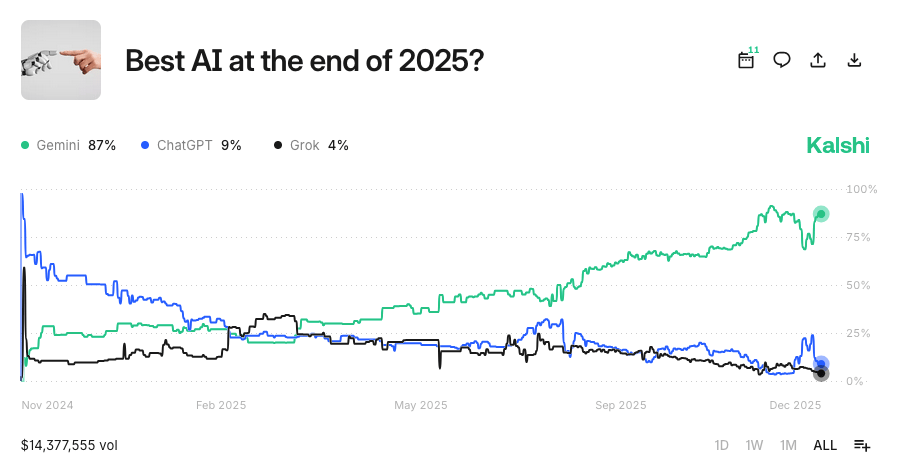
When Kalshi’s prediction market for the best AI model (as measured by the LMArena leaderboard) opened in November 2024, there was broad agreement that ChatGPT would take the cake. However, trust in OpenAI’s model waned throughout the year, while belief in Google Gemini slowly picked up steam.
Interestingly, xAI’s Grok surged to 35% odds to be the best AI model by the end of the year for two weeks in March, surpassing both ChatGPT and Gemini. This was around the time that Grok-3 was released, which outperformed rivals on multiple benchmarks. The lab continued to push improvements for the model over the next couple weeks, but after DeeperSearch and an image editing tool were released, Grok fell behind Gemini — although it interestingly traded more or less in lockstep with ChatGPT’s odds for the rest of the year.
As you can see, prediction markets were bullish on Gemini far before Gemini 3’s release led OpenAI boss Sam Altman to declare a code red at the company. However, Gemini’s chances of victory leaped to over 91% shortly after Gemini 3 was made public.
Other AI-themed prediction markets tell their own little stories. After crossing 40% in the wake of DeepSeek-R1’s release, the odds that a Chinese AI model claims the #1 spot are now around 2%. Bettors were caught off guard by OpenAI’s decision to restructure as a for-profit company, giving the company’s odds of ditching its non-profit structure just a 24% chance. The chances Congress passes an AI law have slowly declined, as have the odds that OpenAI announces it has achieved AGI by 2030.
There is one set of odds that have been increasing though: The New York Times’ chances of winning its lawsuit against OpenAI.
TOGETHER WITH NEBIUS
Nebius Token Factory — Post-training

Nebius Token Factory just launched Post-training — the missing layer for teams building production-grade AI on open-source models.
You can now fine-tune frontier models like DeepSeek V3, GPT-OSS 20B & 120B, and Qwen3 Coder across multi-node GPU clusters with stability up to 131k context. Models become deeply adapted to your domain, your tone, your structure, your workflows.
Deployment is one click: dedicated endpoints, SLAs, and zero-retention privacy. And for launch, fine-tuning GPT-OSS 20B & 120B (Full FT + LoRA FT) is free until Jan 9. This is the shift from generic base models to custom production engines.
MARKETS
Are prediction markets the future of AI news?
For many AI-adjacent folks, relying on prediction markets for truth instead of antagonistic legacy news is a compelling idea. But while prediction markets are useful tools for gauging public sentiment, AI-themed betting markets also create significant potential for corruption and trickery.
A case in point came recently: When a group of prediction market users collectively cashed out over $10,000 on the bet that OpenAI would release a new model by December 13, suspicions arose that the winners had access to privileged information about OpenAI’s product plans, according to The Information.
While it can be suspicious to see bettors win big on somewhat-niche propositions, it’s a bit hard to think anything untoward actually happened. If someone either worked at or had close access to OpenAI, why risk being fired or cut out from one of the most valuable companies of all time for a few thousand bucks?
Either way, for some prediction market boosters, insider trading is actually a feature, rather than a bug, because it guides the market to the truth as efficiently as possible (since prediction markets are not securities, insider trading laws are a little murkier than with the stock market).
Still, these tools are undeniably useful in the right contexts. Both Google and Anthropic have built internal prediction markets where employees can bet with fake money on things like when a given team will finish a project, per The Information.
TOGETHER WITH ASAPP
Give every customer a personal AI agent

We're ready to unveil how ASAPP Customer Experience Platform makes every customer feel like a VIP by uniting your systems, data, workflows, and teams, so you can finally serve customers intelligently, not reactively.
Join us for a free webinar to see what ASAPP CXP means for you:
One platform to serve your customers
Lower cost to serve without lower quality service
AI that understands, speaks naturally, and resolves issues
Easy integrations with your tools—no rip and replace
Happier, more loyal customers
MARKETS
Prediction markets favor Google over OpenAI

Google had a banner 2025, and prediction markets think that momentum will carry into 2026.
Despite expectations that OpenAI’s "code red" will end in January, bettors aren’t counting on Gemini’s downfall. Polymarket gives Google a 74% chance of having the best AI model by the end of March and a 65% chance of leading the race by the end of June. Prediction market bettors’ Google bullishness extends to the public markets. Polymarket gives Alphabet a 36% chance of being the world’s largest company by market capitalization at the end of next year, tied with Nvidia.
The markets don’t see things moving very quickly over at Google’s main chatbot rival, OpenAI. Bettors give the next-generation GPT-6 model a 49% chance of launching by the end of June. They also assign only a 33% chance of OpenAI pulling off an IPO by the end of 2026. And for those jazzed up about Jony Ive’s new consumer device, patience may be required. Polymarket gives OpenAI just a 35% chance of launching a consumer hardware product by the end of 2026.
Interestingly, bettors see a non-trivial chance of AI M&A over the next couple of years. Polymarket gives Perplexity, Anthropic, and OpenAI a 41%, 36%, and 29% chance of being acquired by the end of next year. Apparently, they haven't looked too closely at the eye-watering valuations of those companies, which make an acquisition very difficult.

Take heed before putting too much stock into what prediction markets are saying. Polymarket and Kalshi are heavily advertised to retail traders who are likely not to have any privileged information about things like OpenAI’s IPO plans. Just the fact that two of the highest-valued private companies in the world in OpenAI and Anthropic have higher-than-25% chances of getting acquired next year sets off alarm bells for me that these markets may not be the most rational. Still, even if you just see prediction markets as a barometer for public sentiment, all the OpenAI pessimism is notable from a company that once felt unstoppable. OpenAI will be hoping to prove a lot of prediction market bettors wrong in 2026.
LINKS

AI companies will pivot to efficiency, says Ex-Facebook privacy chief
ServiceNow’s acquisitions give it an “AI control tower,” CEO said
Amazon’s Alexa+ will work with Angi, Expedia, Square and Yelp in 2026
Why generative AI can’t control your house yet

Qwen-Image-Edit-2511: A new image model from Alibaba with stronger consistency and better real-world image editing.
Nano Banana Pro + Gamma: Google’s image model is now available in the Gamma app to create cinematic presentations and slides.
Cursor 2.3: The latest update from the coding platform, with layout customization and stability improvements.

Forward Deployed Engineers embed where decisions happen, translating business priorities into shipped product faster than traditional engineering teams.
While others debate timelines and chase alignment, smart companies deploy engineers who unblock work, accelerate delivery, and reduce iteration cycles.
At Athyna, we provide senior Forward Deployed Engineers who integrate directly into your team:
Modern tech stack expertise — engineers experienced in Python, TypeScript, React, Node.js, AWS, Kubernetes, Terraform, and more.
AI-powered matching finds engineers aligned to your stack and use case.
4 days from brief to interviews—no hiring drag, no bottlenecks.
Save up to $80K per hire vs. U.S. talent without compromising seniority or impact.


POLL RESULTS
Where do you stand on AI slop?
Love to hate it (39%)
Hate how much I love it (27%)
Other (34%)
The Deep View is written by Nat Rubio-Licht, Jason Hiner, Faris Kojok and The Deep View crew. Please reply with any feedback.
Thanks for reading today’s edition of The Deep View! We’ll see you in the next one.

“The star is fixed in a more practical fashion [this image]. [The other image] looks convincing but minor details are too elaborate.” |

“I hate that I get them wrong almost every time now. It’s to the point where I say to myself, ‘This is gonna be wrong, but it’s the one that looks more real.’ I've come to the conclusion that the real images are such that they intentionally look odd.” |


Take The Deep View with you on the go! We’ve got exclusive, in-depth interviews for you on The Deep View: Conversations podcast every Tuesday morning.

If you want to get in front of an audience of 450,000+ developers, business leaders and tech enthusiasts, get in touch with us here.